AI SOC analyst for your security stack
Pay for decisions, not digging.
armor360 is an AI analyst that investigates each alert it is given and hands your team a verdict, with the evidence behind it. Your people review and decide.
- 76 s
- median time to a verdict across our lab runs, with a clear queue
- $0.10 vs $20
- to investigate an alert: armor360 against an analyst by hand, illustrative
- On-premises
- everything, our AI model included, can run in your network
- ElasticElastic Security
- CrowdStrikeCrowdStrike
- OktaOkta
- Microsoft 365Microsoft 365
- AWSAWS
- Palo AltoPalo Alto Networks
- New login on the payments server03:07
- PowerShell downloaded a file03:05
- Many failed logins for j.smith03:04
- New access key for a cloud admin03:02
- Port scan from 10.0.4.702:58
- Script ran on a finance laptop02:55
Alerts from many tools pile up faster than people can read them.
Alerts line up by what matters: real attacks first, each with a verdict and the reason for it.
Works with the security tools you already run
 Elastic Security

 Microsoft Sentinel

 Microsoft Defender
 Okta
 Microsoft Entra ID
 Jira

 Slack
 Microsoft Teams
 PagerDuty
- MISP
 VirusTotal
 Kibana
- AlienVault OTX
- AbuseIPDB
Too many alerts, too few people.
Most alerts are never looked at, and building a team that could look at them is out of reach for most companies.
A day of alerts
4,330
security alerts a day at the average enterprise
37%
of those alerts investigated by its team
63%
not investigated
Each square stands for about 43 alerts. Investigated by the team Not investigated
Source: Ponemon Institute 2026, commissioned by Crogl
The team it would take
9 people up to 14
$1.4M+
a year for a full security operations team: 9 to 14 people, $1.4M to $2.1M with tools
Source: Published estimates
Where we come in
armor360 takes the first look at each one.
It looks into each alert, lays out the evidence and recommends what to do. Your people make the call.
See what changesWhat changes, in time and money.
An illustrative scenario: 150 alerts a day, $60 an analyst hour. Change any number on the pricing page.
| Measure | By hand | With armor360 |
|---|---|---|
| Who investigates | An analyst, 20 min each | armor360, about 76 s in our lab |
| Cost to investigate one alert | $20 of analyst time | $0.10 to run |
| A person’s time per alert | 20 min, investigating and deciding | 3 min to review and decide ($3) |
| Staff time a month | 1,500 h | 225 h |
| Cost a year, staff and running | $1.08M | $167k ($162k staff, $5,400 running) |
| People it takes | 10.5 FTE | 1.6 FTE |
150 alerts a day, $60 an analyst hour, 360 days a year. Before armor360’s own price, which is by quote.
1,275 h a month back
About 8.9 FTE of capacity to put to other work. Capacity, not jobs cut.
$918k a year of staff time
The value of the time freed, before armor360’s price. Not a cash saving unless you change how that time is spent.
About $0.10 to run an investigation
Hardware, power and the model, worked out per investigation: about $5,400 a year at this volume. No cloud AI invoice for each alert.
One reviewer, about 160 alerts a day
At 3 minutes a review, one person can check that many finished investigations in an eight-hour day.
How long the agent takes: a median of 76 seconds an investigation in our lab with a clear queue, and 195 seconds across all 196 lab runs, busy evenings included. The investigation shown on the product pages is one of the deepest: 13 questions in 5 min 35 s. Lab results, not customer data.
From alert to decision, in five steps.
The agent does the digging. People make the call.
- 1
An alert arrives
armor360 takes new alerts from your SIEM and endpoint tools, day and night.
- 2
The agent investigates
It does the routine checking by hand: which machine, who uses it, what else happened nearby, where it connected.
- 3
You get a verdict
Real attack, suspicious, harmless or not sure, how sure it is, and the events behind it.
- 4
Your team decides
It recommends the next step. Your people review, decide and act.
- 5
It learns from you
Corrections become what armor360 knows about your company next time.
Built on your data, with people in charge.
armor360 sits on the security tools you already run. Its agents do the routine work with our own fine-tuned AI model, and keep every step for your people to check and approve.
Your tools
- Elastic Security
- Splunk
- Microsoft Sentinel
- Microsoft Defender
- CrowdStrike Falcon
- Elastic Fleet
- Okta
- Microsoft Entra ID
- Any OIDC provider
- MISP
- VirusTotal
- AlienVault OTX
- AbuseIPDB
- Jira
- ServiceNow
- Slack
- Microsoft Teams
- PagerDuty
- Kibana
- Any tool, by webhook


armor360 platform
AI agents
The routine work of a security team, from the first look to the record
- Investigate
- Correlate
- Hunt
- Tune rules
armor360 AI
Our own model, fine-tuned by our team for security work
- Fine-tuned model
- Runs on-premises
- Data masking
- Company memory
Evidence and control
Every step kept, and every action approved by a person
- Evidence store
- Approvals
- Audit trail
What teams get
- Alert triage
- Faster first look
- Attack campaigns
- Threat hunting
- Detection engineering
- Coverage gaps
- Threat intelligence
- Reports for clients
- Managed security (MSSP)
- Compliance and audit
armor360 AI
Our own AI, inside your network.
Deploy everything on-premises, the AI included. armor360’s model is fine-tuned by our team for security work and runs on your own hardware, so your alerts and logs do not have to go to anyone else’s AI.
Our own AI model
Fine-tuned by the armor360 team for security investigations, not a general chat model.
Fully on-premises
The platform and the model run inside your network, so alert data can stay there.
No cloud AI bill
It runs on hardware you own, so no AI provider bills you for each alert.
Or hosted, if you prefer
The same platform and model, run by us and connected to your security tools.
150+ data sources, through Elastic.
armor360's agent searches whatever your Elastic stack collects, and Elastic's integrations bring in data from hundreds of products across cloud, identity, endpoint and network. 150 of them are on the integrations page; a few:

 Microsoft Azure
 Google Cloud
- Microsoft 365
- Microsoft Entra ID

- Okta
 GitHub
 Cloudflare
 Windows
 Linux
 Kubernetes
 Docker
 NGINX
 Zoom
 Salesforce
- Slack
 1Password
 Palo Alto Networks
 Fortinet
 Cisco

- Zscaler
 Qualys
 Trend Micro

 MySQL
 PostgreSQL
 MongoDB
 Auth0

One platform, more than a first look.
The same agent investigates, joins alerts into attacks, hunts, checks rules and watches your coverage. These are real screens.
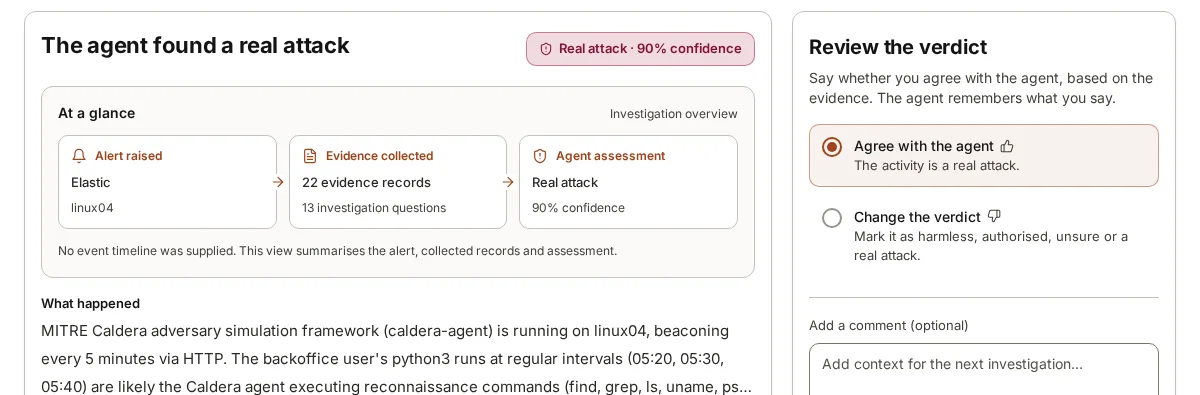
A plain verdict, with the evidence behind it.
The agent works through each alert it is given the way an analyst would, and ends with real attack, suspicious, harmless or not sure, and how sure it is.
- Asks the questions an analyst would
- Collects the records that answer them
- Explains what happened in plain words
Fast, and you can check it.
Speed is only worth having if you can check it. armor360 shows its working and leaves what happens next to your team.
It recommends. People act.
It does not isolate machines, lock accounts or block traffic.
Evidence you can check
Findings link to the log line, lookup or event behind them.
Your data kept apart
Each customer’s data is kept separate from every other customer’s.
A record of what happened
Who approved what, and when, is kept in the audit trail.
Two changes, each approved
It adds missing log collection or switches a rule on only after a person approves.
Your corrections stay yours
What your reviewers teach it is kept with your data, never shared with other customers.
See where your team’s time goes. Then decide.
Start a free pilot on your own alerts, or put in your own numbers first.